Activation Energy

Text Box: Figure 1 Activation Energy with and without catalyst

Figure 1 Activation Energy with and without catalyst

In the world of chemistry, for a reaction to take place the molecules (atoms) need to collide with the proper orientation and sufficient energy (activation energy) for the reaction to take place.  This week neither the orientation nor activation energy were on my side.  If you look at figure 1, you can see red line is very high, meaning lots of energy is needed to accomplish this task, however the addition of a catalyst, Thanksgiving break, is what I need to power through and get everything accomplished.  The activation energy is greatly produced with the catalyst, because it provides an alternate path for the reaction to proceed, in my case a moment to breathe.  I don’t know if there is any helping the orientation of the molecules in the reaction, I guess I can now actually stop and take a deep dive into each of the components and make sure that they are adequate and sufficient for the needs of the course.

Lately I have been thinking a lot as a student (I have been a student for many years of my life) if I have ever really cared about the objectives and goals of a course.  I can remember thinking what the topic of today’s lecture is so notes could be properly labeled, but not once do I recall ever thinking to myself what objectives are being covered today or for that matter the goals, I do not know if they were ever provided.  I just went to class and did what was instructed of me.  With that said, maybe I would have been a better student if I had cared or looked for them, but there is no changing the past.  Anyway, this brings me to I need to add the objectives to my lessons on the off chance one of the students cares and wants to know how each objective aligns to a standard.   

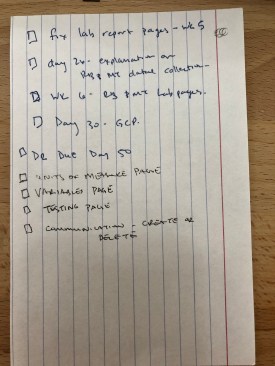
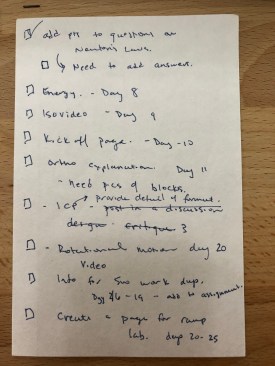
I know I am jumping around here, but this past week I went through each week of the course and looked at what I still need to fix/adjust/add to make the course flow, sort of like a punch list at the end of construction project.  It is all the finishing details that take the longest and that is where I am at.  Here is my punch list, I know it looks like a lot, but it is really not that bad.
A close up of text on a white background

Description automatically generated
A close up of a piece of paper

Description automatically generated

Authenticity

Back to making videos:  because this is being adapted from a face to face course, I have a lot of PowerPoints that I use in class as the base for discussions and lessons.  This past week I looked at what I have left to convert to videos to see if there were any that could be conveyed with just text and appropriate images as necessary and I began to lay out some of the pages.  What I feel that they are missing is authenticity.  I like to conduct class in such a manner that we are having a discussion in class rather than just listening to me talk about a specific topic.  What I have discovered about myself and online learning is at times I feel it has lost its authenticity because more often than not it feels like checking off boxes or meeting a metric rather than real and engaging.  I know that this is difficult to achieve when a course is completely asynchronous and there is no correct answer on how to make it feel more engaging.  I guess by creating the videos the students will hear my voice, I don’t think I will ever put my face on the video, and not just feel like they are doing it on their own but know that there is a real person on the other side of the computer.  I appreciate all your comments and the weekly updates, because it does make it feel more real and authentic when we are all spread out across the country.   This brings me back to making videos, the same thing I have been talking about for the past month and will be doing until the end.

October is Finally Over

Photo by Ylanite Koppens on Pexels.com

I feel like the smaller pumpkin being eaten by October. I do not know if professors in higher ed experience the same dislike of October as K-12 teachers do, but I am thankful that November is finally here.  What has happened this week, not much.  I love that it appears that my course is finished from the eyes of my partner, but it is anything but finished.  I feel like this is how construction workers must feel like when they begin to finish out a home after the exterior and interior walls are up, here comes all the work.  That is my course the walls are up, but all the finishing touches need to be finished.  I just finished this portion of the course face to face with my current students and oh the take aways.  I need to incorporate more peer feedback as well as practicing for their presentation, I believe that this will be done by creating groups of three to four teams and having them conference and present their design and what challenges they are experiencing on a weekly basis.  I have come to discover that many students are missing gaping flaws in their design, because they just can not see them, because they have been so engrossed in their thoughts, that to them everything is perfect, and it is not.  I am toying with the idea of breaking the log book discussion feed up into weeks rather than one continuous one, it is much harder to grade and keep track of posts when there will be 45 as the course runs for 9 weeks as opposed to 5 per week.

I am still working on making sure that all the links are functional as well as video.  One of the most annoying things I find with Canvas is that items will be viewable to me the teacher, because I have access to all the links, I created them, and from student view it is not always possible to test if they work or not.  Sometimes you can see them and sometimes Canvas just says this is not viewable in this mode, how am I to know if they work. I guess that is were my partner comes in and I can specifically request that they look at specific items.  Speaking of partners, I gained a new partner this week.  As you are most likely very aware, Nicole’s partner had to drop the course and she needed a new team.  I am not sure what my original partner thinks about it but bring it on.  I am always willing to help anyone out in need, it is what we should all do.  I hope to be added to her course tomorrow and will hopefully get her some feedback tomorrow night, now that dreaded October is over.

Running out of Steam

I do not have a lot to say this week, and I am willing to take the loss.  While I had grand intentions for the week, create two videos, neither happened.  I had sick children and grading at work is kicking me hard.  The bane of education, grading.  So now the plan is to spend quality time this week getting ready for the videos.  I guess I really need to decide is it necessary to make videos or can I take the content out of the PowerPoint and onto a page and have the same affect?  I know in the long run taking the time to create the explanatory videos is going to pay dividends, but it is finding the time and quiet space to get it done.  I know this is exactly what I talked about last week, but it is still there, and this will probably the thing I will be working on for the remainder of the course, because I have completed the bones, now I am just adding the meat. 

I did spend a quality hour helping my partner navigate Canvas and figure out how it works.  After repeated offers to help her out with the navigation, she finally took me up on it and hopefully she is feeling more comfortable.  Canvas is not always as intuitive as one may think, I am probably speaking to the choir here, and can be out right frustrating at times.  But after showing her the ropes, I think she has it.

Yes the answer is make the explanatory videos, it will alleviate so many questions in the future.

Making Videos

Making Videos

After I got over my initial heart attack of, I was going to have to cut and paste all of the HTML into all of the different pages, I don’t, I am now left with finding all of the files that have been linked/embedded using the Google LTI feature.  This is will be time consuming endeavor, but hopefully my file system is organized enough that it will not take forever. It was very kind of my partner to saw that the links worked, some of them work, but most just take you back to the homepage until I locate and relink the majority of the files. 

 I decided to adapt a portion of a course I currently teach face to face into an online version.  Even though I will never teach this online, I know I can use everything I am creating in my face to face course.  I currently have PowerPoints of all the material I would introduce in class, because this is not going to happen, I need to add voice overs to all of them or turn them into some other form of instruction that is not PowerPoint.  Making videos is time consuming and, quite frankly, I don’t like to listen to my own voice but it I will get over it.  I know that the time I put into this now will save me in the long run if I continue to teach this course or whoever comes after me, because the content will all be there and instead of answering the same question twenty times, I can point them to the video.  I have already seen this reduce questions and increase understanding with some of the content but not all, it is always a work in progress.

I just took a moment and reviewed my time line I created, well October is basically half way over and I have completed one or two things on my list.  I need to step up my game, if I am going to get this all finished in 6ish more weeks.  I need to heed my own warning that I tell my students daily, just because it seems like you have a long time until the due date does not mean you actually do, get a move on.  With that said my goal this week will be to create the explanation for the storyboard/quantitative analysis and the qualitative analysis.  I don’t know if these will be videos or rather a handout of sorts, but I will make it happen.  Making videos is exhausting.

Canvas

Under Construction

Canvas, where to begin.  I have a love hate relationship with this program.  Sometimes it is great and sometimes it frustrates be beyond belief.  Changing documents embedded using the LTI from the original.  How many times can you resave a document before you give up and just upload photos, so it retains the equations you need? Too many.  I use Canvas to host my course within the district I work for and instead of reinventing the wheel, I am using a section of my course that could be taught on line for this project, therefore I have been building everything within the my work Canvas and not the free version of Canvas, well just likely everything that is free out there, it has size limits, and the current version of the course and not the final version is to large to use the export package, now I either have to sacrifice content or I have to cut and paste all of the html code into canvas for each page and there are a lot of pages.  In my mind it was going to be soo easy.  Create it in the current course I am teaching, copy it to a sandbox course for tweaks and then finally export it to the course for the class.  Well, everything does not always go according to plan and I will make it work, because that is what you do.  I will be spending the next while copying and pasting, good times.  I have or at least I believe I have successfully transferred all of the files to the course, which will hopefully make the copying and pasting aspect easier, because the files already exist, and I do not also have to add those.  I had a breakthrough.  Free Canvas said the size of the files exceeded the free legal limit, well I went and checked out all of the files it was trying to export in the package and realized that there were quite a few that were not part of the online version and low and behold with some strategic deleting the export package was small enough and my course now exist in free Canvas.  I use the LTI function quite a bit with work, but they do not speak to each other here, I need to spend the next few days locating the files I had embedded/linked using the LTI and making them available, less daunting than the thought of copying and pasting a bunch of HTML.

I have not had much contact with my partner.  She has yet to accept my offer to view my course and as far as I can tell has not added me to her course.  I have sent her the details of my course and that there is material for her to critique for me.  I feel that she may be feeling overwhelmed after the completion of the design document.  All in good time.

Landamatics

When looking at the various ID models out there I came across the Algo-Heuristic Theory by Lev Landa.  The title stuck out to me because a few years back I had a mini pedagogical crisis when asked by a student when they were ever going to use this again and the answer was probably never.  Why was I spending so much time and effort in teaching if a lot of them were never going to use it again.  I gave the pat answer I am teaching you the skills necessary to solve any problem out there, but was I really?  This led to the inception of 20Time in the classroom, which has since become it’s own standalone course, when I first read about how our educational system is algorithmic and we do not allow for heuristic learning (Bookhauser, 2015).  I thought, well maybe the Algo-Heuristic Theory falls along this same concept and decided I would explore it deeper, it has nothing to do with this, but it was interesting non  the less.

The Algo-Heuristic theory developed by Lev Landa in the 70’s, known today as Landamatics, basically states we are all doing it wrong.  “Everyone maintains that school should not only impart knowledge to students but teach them how to think, how to solve problems….Why are schools unable to teach thinking?” (Landamatics Ten Years Later: An Interview with Lev N. Landa, 1993).  To answer the question Landa states that “Thinking is not knowledge. Thinking is what one does with—and on – knowledge in his or her mind, how one transforms it and operates with it.” (Landamatics Ten Years Later: An Interview with Lev N. Landa, 1993).  Landa proposes that as educators we need to teach students not only knowledge but a method (algorithm) by which to apply the knowledge to solve problems, any problem. The heuristics come in because even creative processes are solved using systematic methods, what is heuristic for one may be algorithmic for another and it all depends on the approach one takes.

Landamatics is quite simple allowing students to take what knowledge they have and apply a method to use this knowledge in solving problems.  Methods are broken into two types Ma, system of actions, and Mp, system of instructions or a prescription (Landa, 1998).  By combining the two methods it is possible to come up with a systematic approach to problem solving that can be used at various levels and across a wide range of problems.  Landa has developed various approaches depending on whether the problem is conjunctive, disjunctive, or logical.  Outlining the whole process is outside the scope of this blog but the premise is quite basic, provide students with a system of steps to problem solving instead of providing guided examples to problem solving.  We have all encountered students who can solve problems if they follow the same process of the examples but if the problems deviate slightly from the example they do not know where to begin.  The most basic method of Landamatics is laid out in general method 2 (Landa, 1998).  By following this process students can apply knowledge to a wide range of problems and begin formulating answers on their own without teacher intervention.

Most ID models I am familiar with teach how to design a course, this however goes beyond that but is providing a method to teach thinking not just laying the structural foundation.  It closely follows the constructivist framework because it requires students to take what they know and apply it, but it requires the development and application of an algorithm/method to develop a solution.  Students are required to apply pervious and new knowledge to problem solving while developing thinking skills.  The instructor moves away from the role of teacher and into the role of facilitator as students develop models of problem solving.  Like any new theory/model/method there must be buy in from all stakeholders.  The instructor must be willing to move from role of teacher to facilitator, but this is not dramatically different from many models today.  Like any new model, everyone must be willing to take risks and be ready for any bumps along the way.

References

Bookhauser, K. (2015). The 20Time Project: How educators can launch Google’s formula for future-ready innovation. CreateSpace.

Landa, L. N. (1998). Landamatics Instructional Design Theory and Methodology for Teaching General Methods of Thinking. Landamatics International.

Landamatics Ten Years Later: An Interview with Lev N. Landa. (1993, June). Educational Technology, pp. 7-18.

Validation

I must admit, I was a bit nervous submitting my design doc after the first week’s meeting, when we were told, you will most likely get your document sent back with the need for rework, lots of rework.  Well, I went for and did I what I have always done, design instruction.  Now, in education do you rarely design according to the format required, but the basics are all the same, who are you designing for, why are you designing, define goals and objective, and develop meaningful exercises and resources, no fluff. Thank you for the addition of the example for reference.  Whether following this particular format or what I usually do, ok the format is definitely more organized and helpful, I must follow my beliefs on education and learning.  When I am finally designing for someone else, I will abide by theirs.  So I designed and it worked in my favor. 

I am fortunate that I had few revisions/additions to make.  I did add that the goals and objectives were adopted from Texas Education Association, Texas Essential Knowledge and Skills for Career and Technical Education Subchapter O. Science, Technology, Engineering, and Mathematics (2015).  As well as assigning the appropriate goal and objective to each learning activity and not the module as a whole.  I also corrected a few spelling/grammar issues pointed out by my partner.  I feel very good about what I created and am started to feel validated as a designer.

Motivation

We can all agree that learning is more enjoyable when we are learning something we care about, when we know that it is something, we will need in life again.  However, this is not how education works.  Yes, there are times that we learn something interesting, but most of the time students complain about when will we use this in life and often, I usually reply you won’t, but it will teach you how to problem solve, a valuable life skill.  How then do we motivate students to want to learn and not for the sake of a grade?  Before one can feel motivated it is necessary to meet the lower order needs before higher order needs and students need to feel that they can succeed (Cheng & Yeh, 2009).  As a fledging instructional designer how do I create content that will motivate, when most likely, the students could care less about the content? 

I have found that after most readings throughout the program it has caused me to stop and reflect, how I can be a better practitioner.  I find that I keep coming back to the current educational model is broken and is highly algorithmic with little ability to prove success after failure.  Students are motivated by grades and not intrinsic purposes.  I have seen many students shut down after one failing grade, because we do not afford them an opportunity to learn and correct the failure.  This is because we need to teach X content in Y days.  This leaves no time to address misconceptions and unlearned material leaving students unmotivated.

Is the answer problem-based learning, flipped, or blended learning?  I don’t know, but it is a method often cited when talking about student motivation.  The models are based off a constructivist approach that require students to learn and build from experiences.  Savery and Duffy note that “learning must have purpose beyond, ‘It is assigned’” (Savery & Duffy, 2001, p. 3), this is paramount when we are required to have a certain number of grades a week and work is assigned because a box needs to be checked.  I find myself coming up with reasons why these will not work, and they are excuses because it causes me to step out of my comfort zone.  My most often cited excuses are time and resources.  To run a true PBL course, there needs to be more of me because each team is assigned a tutor (Woltring, Herrler, Spitzer, & Spreckelsen, 2009), and that is just not going to happen in K-12 education.  While I do teach a project-based course, I think in theory I could convert it to a blended PBL course.  Because most of the work would be completed online, it would afford me the opportunity to meet with each team in a somewhat timely manner.  But will it increase student motivation, only time will tell, and I need to be willing to take risks.  The worst that will happen is that it will be a failure, but that is ok, because I can learn from it and move on.

References

Cheng, Y.-C., & Yeh, H.-T. (2009). From concepts of motivation to its application in instructional design: Reconsidering motivation from an instructional design perspective. British Journal of Educational Technology, 40(4), 597-605.

Savery, J. R., & Duffy, T. M. (2001). Problem Based Learning: An instructional model and its constructivist framework. Bloomington: Center for Research on Learning and Technology.

Woltring, V., Herrler, A., Spitzer, K., & Spreckelsen, C. (2009). Blended learning positively affects students’ satisfaction and the role of the tutor in the problem-based learning process: results of a mixed method evaluation. Advances in Health Sciences Education, 14, 725-738.

Will it Work

This week was all about tying up loose ends and making adjustments based on client feedback.  What a push is was.  I spent a few days creating the slides for the videos and then recording them.  Because my kids are home for the summer and it is anything but quiet in my house, I spent a few hours in closets and bathrooms, trying to find quiet space to record.  Don’t worry there are no images of me talking.  I find narrating videos, quite challenging because you are talking to yourself.  I have used different programs over the years to create videos, and in all honesty I should have created a trial version of Articulate 360, but decided upon a free screen casting program, Loom.  While the quality of the video is excellent, at least to my standards, it does not allow the option to add captions.  I now have to go back and caption everything using Adobe Primer.  While this is more of a nuisance than anything it has taught me to do my research first and stick to the script.  I failed at that part.  While I did right everything down, I found it difficult, at least for me, to read the script while narrating.    I will now focus on listening to all of the videos and creating a script to create captions.  I think I will do some research this week on if there are any programs that can help me do this.  Again it is more of  nuisance than anything, but it will pay off in the long run.  Maybe I should not have read any of this because no you know the videos are not captioned, but they will be by the final submission.

Overall I feel good about the design.  The goal was to create a differentiated lesson based on the results of four pre-tests.  The questions within the pre-tests are divided by objectives.  The quiz is designed to instruct students to complete certain tasks/activities based on the feedback from the quiz.  In my head it is going to work beautifully, but I do not know if this will happen in reality.  The downfall may be that I put everything in as a mastery path also.  While in theory mastery paths are a good idea they are based off of score and not concepts.  A student may score below the desired 80% and based on the mastery path be assigned an activity on a concept they have mastered and not the one they are deficient at.  The goal is to assign based on deficits and not score alone, this is why the change was made to use the feedback from the quiz questions directly.  Students will be given an individual rotation playlist to help them track their “must do’s” and “may do’s”.  Only time will tell if it works as envisioned.